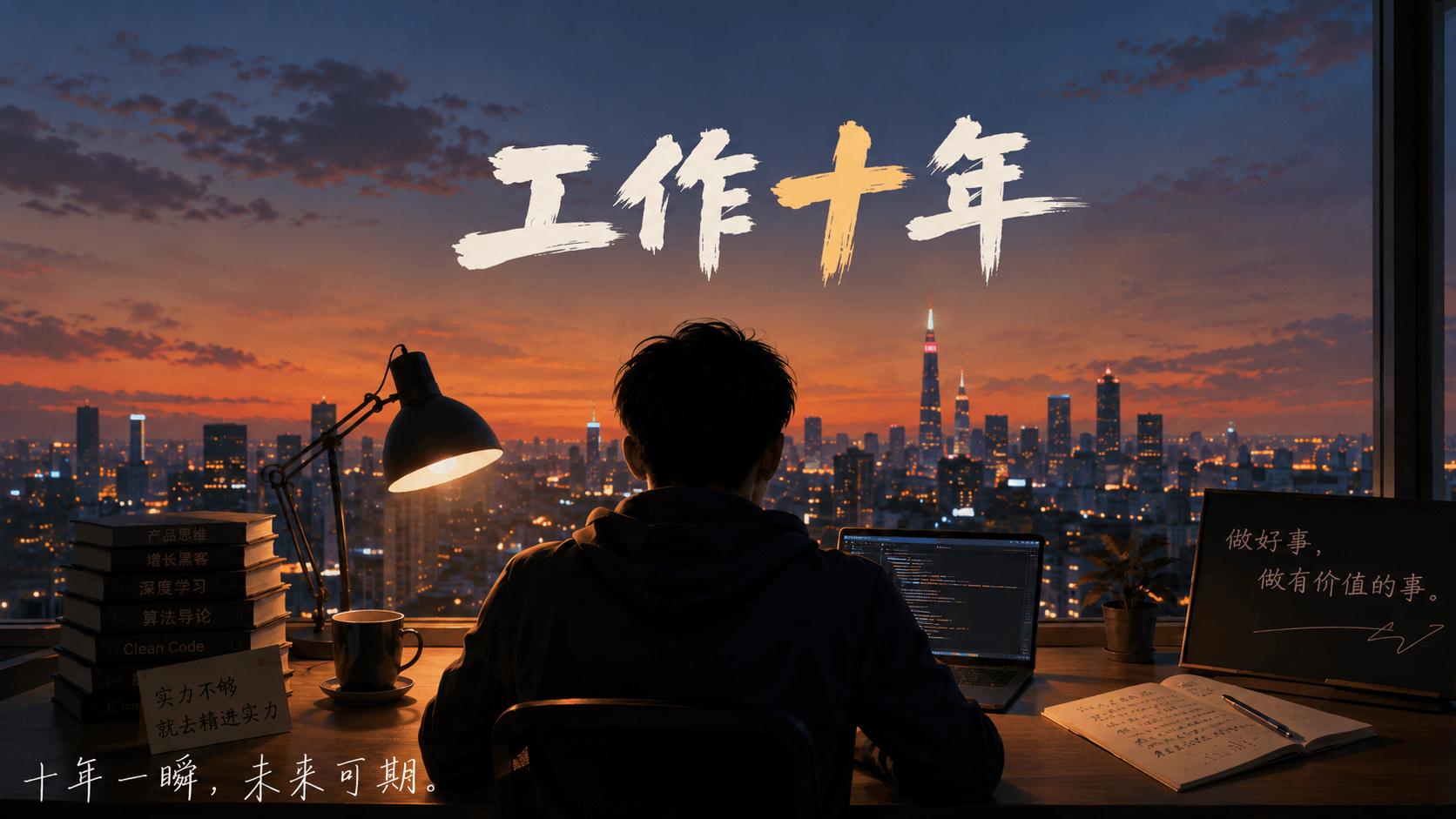
If I were to count carefully, I actually started working long before 2016.
The summer after I finished middle school, I worked as a laborer on a construction site.
I was young then and had no real idea what the word “work” meant. I only remember how brutally hot it was every day. Under the blazing sun, the ground beneath my feet and the steel bars around me seemed to radiate heat. When I got desperately thirsty, I sometimes stopped caring whether the water was clean or not and simply scooped a few mouthfuls from the water sitting in a construction cart.
Looking back now, that was probably the first time I earned money through my own labor.
After the college entrance exam, I worked as a security guard at the construction site of Tongzhou Wanda Plaza, which was still being built at the time.
There was nothing glamorous about that job. I stood guard during the day, sat in the security booth at night feeding mosquitoes, and did many things I can barely remember anymore. When it was finally time to ask for my wages, I almost got beaten up.
During university, I also took quite a few part-time jobs. I did offline promotions, asking people to register for apps in exchange for small gifts. I worked as a waiter too, carrying dishes at a grilled fish restaurant.
So if “working” simply means exchanging your time and physical effort for money, then I started working quite early.
But if you ask me when I truly felt that I had entered the adult world, I would still say:
**August 8, 2016.**
That was the day I began my senior-year internship.
By the end of my third year at university, there were very few classes left. Most of our time was reserved for internships and what the school called “social practice.” I attended an ordinary university outside China’s elite university system, so my academic background gave me little advantage. Finding a job was, unsurprisingly, not easy.
Sending out resumes.
Going to interviews.
Getting rejected.
That was the first time I understood that walking from school into society was not as simple as opening a door and stepping through it.
In the end, I managed to get an interview at an internet recruitment company by simply showing up and pushing for the opportunity.
The role was app promotion.
Looking back, it was hardly an important position. But at the time, I treasured it enormously.
When someone has run into wall after wall and finally finds a place willing to give them a chance, that opportunity can suddenly feel incredibly important.
So during that period, I often stayed at the office voluntarily until nine at night.
One day, my team lead saw that I was still there and asked me:
> “Why do you work so late every day?”
I gave him an answer that I still remember today.
I said:
> “I’m working overtime now so that I won’t have to work overtime in the future.”
Ten years later, the sentence feels a little funny.
Because I eventually realized that this imagined “future” never arrives automatically.
From then until now, overtime has instead become one of the most ordinary parts of working life.
When we are young, we tend to believe that most hardships are temporary.
Just get through this period and things will be fine.
Work a little harder and things will be fine.
Wait until the salary gets higher.
Wait until the title gets better.
Wait until the company succeeds.
Only later did I gradually understand that life does not seem to contain some clear turning point after which every problem suddenly disappears.
Problems simply turn into different kinds of problems.
That first internship never turned into a full-time offer.
When I graduated from university, I boarded a train to Beijing again.
On the train, I opened a letter written to me by one of my classmates.
I can no longer remember much of what it said, but I remember that as I read it, tears suddenly began to fall.
I wasn’t sobbing.
I just sat there, unable to stop the tears.
Looking back, I think it was because I suddenly realized that a chapter of my life had truly ended.
My student years were over.
University was over.
Many people I once thought would always remain part of my life would gradually drift away.
Youth doesn’t really have a farewell ceremony.
One day, it simply tells you:
This is where it ends.
From here on, you are responsible for yourself.
For a while after that, I gradually came to accept something:
**Disappointment is the normal state of life.**
When I was younger, that sentence sounded depressing.
As I grew older, I realized it wasn’t pessimistic at all.
Because once you accept that disappointment is part of life, a single failure no longer makes you feel as if something is fundamentally wrong with your life.
After graduation, I stayed in Beijing and continued looking for work.
Eventually, I joined an internet finance company in a business development role.
It was called business development, but in essence I was still helping apps find new channels for growth, so the work wasn’t very different from my first job.
Later, I transferred internally and went back to app promotion.
Those years were probably the last truly exciting chapter of China’s mobile internet boom.
Traffic, growth, distribution channels, user acquisition, apps — everyone was talking about these things.
And I was right there in the middle of it.
Gradually, I began to feel that I understood a few things.
I knew where traffic came from.
I understood how products acquired users.
And I had a rough idea of how an internet product could make money.
After about two years of working, I felt that the timing was right.
So I decided to start my own business.
Looking back, when you’re in your twenties, it’s very easy to overestimate how much you know.
Once you understand a few patterns, you start to think you understand the entire world.
Entrepreneurship quickly taught me otherwise.
What I knew was nowhere near enough.
At first, things actually went fairly well.
I made some money and earned what people like to call their “first pot of gold.”
For a while, I began to think that maybe things weren’t as difficult as I had imagined.
I even developed a kind of illusion:
Maybe if you work hard enough, you can make almost anything happen.
But as I tried more and more things, that illusion slowly disappeared.
Especially later, when I started building apps for the Chinese market, I often had the same feeling:
**Every time, it seemed like I was just a little bit short.**
The product was a little short.
The timing was a little short.
The market was a little short.
The team was a little short.
Even luck was a little short.
You could see the opportunity right in front of you. Sometimes it felt close enough to reach out and grab.
And yet somehow, you still missed it.
For a long time, I attributed some of those failures to luck.
Later, I realized that luck was actually the easiest explanation.
Luck is a very convenient answer.
A project fails — bad luck.
You miss the market — wrong timing.
The product doesn’t take off — too much competition.
Sometimes those explanations are completely valid.
But the problem is that if every failure is ultimately blamed on luck, then you never have to change yourself.
So I began to revisit the products that had failed.
Gradually, I admitted something that I had not really wanted to admit before:
**Many times, it wasn’t that the opportunity never came. It was that my abilities weren’t ready when it did.**
Technology was the biggest example.
I had worked in growth, business development, and product. I knew what I wanted a product to look like, and I understood where users could come from.
But I didn’t understand the technology itself.
When development kept getting delayed, I had no real ability to judge whether the delay came from a genuinely difficult technical problem or simply poor execution.
When a developer told me that a feature would take another two weeks, I didn’t have enough technical understanding to know whether it should really take two weeks, two days, or two hours.
I could push people.
I could hold meetings.
I could set deadlines.
But if you don’t truly understand the thing you are managing, then what an entrepreneur calls “management” is often just looking at the problem through a pane of glass.
I couldn’t truly control the development of my own products.
And that eventually became the source of many other problems.
It also led me to one of the deepest reflections of those years:
**Of course luck played a role in many of my failures as an entrepreneur. But if I had to identify the one thing most worth changing, it was simply that I wasn’t capable enough yet.**
That answer is harsh.
It is easy to admit that you were unlucky.
It is much harder to admit that you simply weren’t strong enough.
But strangely, it was also an answer that gave me a sense of peace.
Because you can’t train luck.
You can train ability.
During those years, I also came across quite a few opportunities to make quick money.
Some of it honestly wasn’t difficult to earn, as long as I was willing to do certain things.
But gradually, I became wary of it.
I was afraid of making too much easy money.
Not because there is anything wrong with money itself.
But because when money comes too easily, it becomes very easy to start making every decision around short-term results.
Whatever makes money today, do that.
Wherever the traffic is tomorrow, go there.
When the next trend appears the day after, switch directions again.
None of those individual decisions are necessarily wrong.
But ten years later, you may suddenly look back and realize that you have done a little bit of everything without truly accumulating anything.
I have always wanted to build something genuinely valuable.
For a long time, I simply didn’t know what that thing was.
In 2022, I began paying serious attention to generative AI.
At first, I was mostly interested in image generation.
Then, toward the end of that year, the arrival of GPT-3.5 and ChatGPT made me realize something very clearly for the first time:
Generative AI might not simply be another product category within the mobile internet era.
It might be the beginning of the next major technological wave.
A huge amount of software may be rebuilt.
Companies may be reorganized around it.
Even the way many kinds of work are organized could be rewritten.
I became increasingly certain that I wanted to be part of it.
But a familiar problem soon appeared again.
If I wanted to build AI products, understanding product and growth was no longer enough.
I found myself back at the same problem that had held me back before:
Technology.
If I wasn’t capable enough, then I had to make myself capable enough.
So beginning in 2024, I picked computer science back up.
I started writing code again.
I began learning the things I had once assumed could simply be “left to the programmers.”
I started building products myself.
And I began studying the underlying logic of generative AI.
Why can a model generate text?
How can an image emerge from noise?
What problem does the Transformer actually solve?
How should an Agent work?
What should a truly great AI product look like?
The older you get, the harder it becomes to start learning something all over again.
When you’re twenty and fail to understand something, you simply think:
I didn’t get it today.
After thirty, you begin unconsciously calculating time.
Is there still enough time?
Am I starting too late?
Other people have already been doing this for years. Can I still catch up?
Eventually, I figured something out.
If I intend to spend the next ten years doing this anyway, then right now is the youngest I will ever be for the rest of my life.
So what is there to hesitate about?
I once set a goal for myself:
**Before I turned thirty, I had to find something worth dedicating my life to.**
For a long time, I imagined thirty as some kind of dividing line in life.
As if by that age, a person should know who they are.
They should know what they want.
They should know where they intend to go for the rest of their life.
But the expectations we have for our lives and the lives we actually end up living are rarely perfectly aligned.
At thirty, I still hadn’t found the answer.
I was still searching.
Still anxious.
Still unsure whether the things I was doing today would mean anything ten years later.
But at thirty-one, things suddenly became much clearer.
I no longer felt such a strong need to prove how much money I could make.
I no longer felt such a strong need to prove that I was smarter than other people.
Of course those things still matter.
A company needs money to survive.
A product needs growth if you want more people to use it.
And no entrepreneur can honestly say that success doesn’t matter.
But those things should not become the ultimate goal.
If you ask me today what I want to spend the next several decades doing, my answer has become surprisingly simple.
**Do good things.**
**Do things that create real value.**
Those words can sound empty.
They may even sound like the kind of statement that is technically correct but says almost nothing.
But it took me ten years to slowly understand what they actually mean to me.
Doing good does not necessarily mean pursuing some grand moral mission.
Sometimes it simply means building a product that does not deceive its users.
Not making money by exploiting people’s anxiety.
Not doing something you already know has no long-term value simply because it offers short-term profit.
And if you have the ability, trying to make a few things slightly better because you were here.
Doing valuable things doesn’t necessarily mean changing the world either.
I simply hope that ten years from now, when I look back, the things I am doing today will still feel meaningful.
That they can accumulate.
That something remains.
That they genuinely help someone.
And if I am lucky, perhaps they can even push technology forward a tiny bit.
From August 8, 2016 to today, it has been almost exactly ten years.
The young man who voluntarily stayed at the office until nine every night ten years ago probably never imagined that he would become an entrepreneur so early.
He would never have imagined that one day he would go back and learn programming again.
He certainly would not have imagined the arrival of AI.
And he probably wouldn’t have imagined that ten years later, he would still be staying up late because of a product.
Maybe the only part of that old sentence I got right was the first half:
I’m working hard now for the future.
What I didn’t understand then was that “the future” is not a place where you finally no longer need to work hard.
It simply means that one day, you finally understand where your effort should go.
Over these ten years, I have worked in app promotion.
I have worked in business development.
I have been an entrepreneur.
And eventually, I became a programmer again.
I have made money.
I have missed opportunities.
I have succeeded at some things.
And I have gone through more than a few failures.
If I had to summarize these ten years, I wouldn’t call them a “ten-year story of struggle.”
They haven’t even been particularly successful.
I simply spent ten years gradually becoming aware of my own ignorance, limitations, and weaknesses.
Then I spent a long time learning to accept them.
And finally, I decided to make up for them, one by one.
I used to believe that the most important thing in life was to find the right answer as quickly as possible.
Now I think perhaps life never comes with a correct answer written in advance.
A person’s direction is often something that slowly emerges through one choice after another.
What you choose to do.
What you give up.
What you insist on.
What you refuse.
In the end, all of those decisions come together and become who you are.
At thirty, I still hadn’t found the thing I wanted to devote my life to.
At thirty-one, I found it.
So being one year late doesn’t seem like such a big deal.
There is still a long life ahead.
I want to work on things that are genuinely difficult, but worth accumulating over the long term.
And then, as much as I can:
**Do good things.**
**Do things that create real value.**
As for how far I can ultimately go,
I’ll leave that to time.